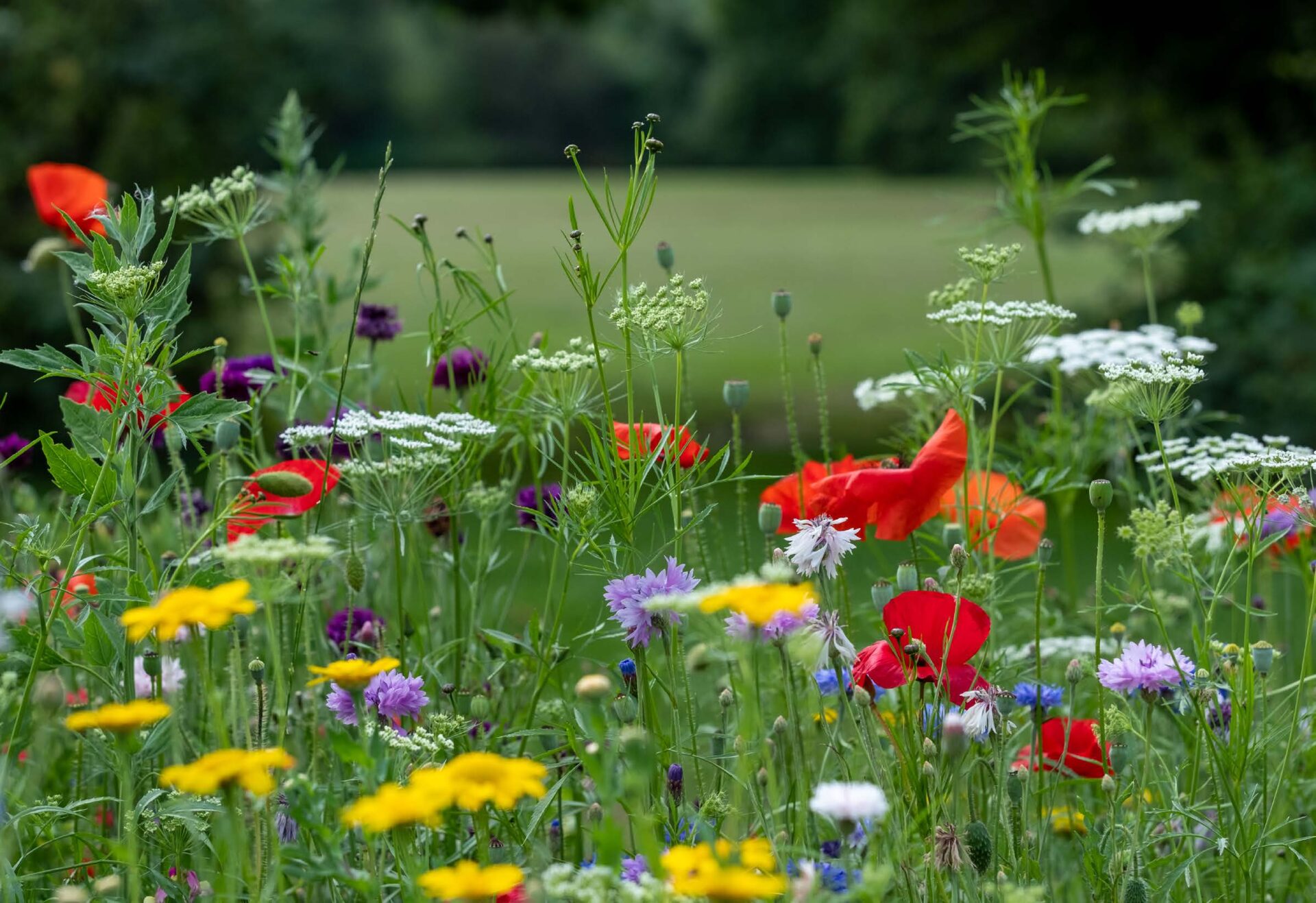
Our ecosystems and habitats have evolved with a range of species that have adapted to survive and thrive in the UK’s environmental conditions. Planting native wildflowers means that you are using plants suited for our landscapes, environments and wildlife. Using non-native plants can carry higher risks of disease and require greater levels of maintenance.
Our seeds are harvested by a variety of suppliers throughout the UK. Some seed comes from wild meadow harvests whilst other seed has been cultivated from wild seed that has been found in various locations and cloned to produce it at scale. All our seed is of a UK origin.
If you are creating a meadow from scratch, you will need a complete mixture of grasses and wildflowers. If you are sowing onto existing grassland then you can use 100% wildflower mixes, equally you can also use complete mixtures if your site has a limited range of grasses. Once you know this, then you should find out your soil type by using a simple soil test and select one of our mixes that matches with your soil type. Other factors such as aspect, drainage, and pH can determine the best seed mix for your site. Our British Flora ‘Easy Sow’ app can help choose the right seed mix for your site.
Our General Meadow Mix (BFS8) is well suited to a variety of soil types, and the range of species will provide results in most scenarios. If you have a high fertility site however, we recommend our Heavy Clay Soil Mix (BFS4).
Our Hedgerow and Shade Mix (BFS6) is best suited for sites that receive partial shade and lower levels of direct sunlight. Most wildflowers will relish full sun and so the majority of our mixes are suitable for sites with full sun.
The amount of seed will depend on your area size. So firstly, you need to measure the dimensions of your site to get an estimate of the area. With straight sided sites this can be done easily by multiplying the width and height of your area. With a more complex shaped site it is sometimes easier to use a map software, such as Google Maps, which allows you to draw the boundaries of your site and will give you the area. We recommend sowing seed at 2-3 grams per metre squared. So, for example, if your site is 500m2 and you are using 3 grams per metre squared, multiply your area by 3 and that will give you the weight of seed. In this case 500 x 3 = 1500g, so you would need a 1.5kg wildflower mix.
Yes you can. In some cases, certain species are more successful as plugs compared to seed. Using a combination of the two means that you can have instant results (as plugs) and broad coverage using seed.
Most meadow mixes are made up of perennial wildflower species (Yellow Rattle is an exception), whilst our Poppy and Cornflower Mix is made up of annuals.
This is not completely necessary as nature will work its magic leading up to germination, however, if it is extremely dry after you have sown your seed and have a small patch it wouldn’t hurt to water it; but generally, you don’t need to.
Once you have sown your seed you should lightly tread it in, however once it has started to germinate you should avoid walking on it so that you do not damage any growing seedlings.
Yes, you should scarify the area, for detailed guidance please look at our advice page.
No, definitely not. Wildflowers do well in low nutrient conditions so adding any type of feed or fertiliser will only benefit the grasses and weeds which will outcompete the wildflowers and leave you with a meadow dominated by grasses and weeds.
Yes, on our advice page look at the ground preparation guidance for restoring a meadow.
This is very common so do not be worried. Ox-eye Daisy is very good at establishing quickly and will do well on most soil types. After your first few cuts in Summer and autumn you will notice other species coming up and reducing the dominance of the Ox-eye Daisy.
We would recommend having yellow rattle in the majority of meadow scenarios. Yellow rattle is key in helping the other wildflower species to establish. Without it, grasses are more likely to dominate and make it harder for wildflowers to establish.
This can happen due to a number of reasons. One of the most common reasons is that the correct management has not been followed. It is important to cut your meadow around July to remove the grasses, you can keep cutting or grazing up until March to keep the grasses down. Secondly, your yellow rattle may not have established yet.
Generally, wildflower seed can be stored for long periods of time in the correct conditions. Typically, it should be stored in a cold store at 1-4 degrees Celsius. Please look at the seed storage section on our advice page for more details.
Most of our seed mixes are not toxic to animals, the only ones that could cause potential trouble are mixes with Toadflax, Foxglove and Water Dropwort in. It is good to remember that some species are just not palatable for livestock, however they are not toxic.
Firstly, there are a few construction steps, typically it involves having a roof base, then a waterproof membrane, then a root barrier of some sort, then a specially designed drainage level, then a filter fabric level and then your substrate
It depends on what you mean by enrich, generally, they won’t boost the fertility of the soil as in a wildflower meadow nutrients are taken away from the site. However, they will enrich the soil by forming complex root structures which will aerate the soil, improve its water holding ability and filtration, and increase microbial activity in the soil. Also, they will attract a variety of invertebrates which will interact with the soil biome and create diversity.
Loam is a type of soil that is composed of predominantly sand and silt, and a small percentage clay. It tends to be water retentive, free draining and nutrient rich. It is often regarded as a great soil for growing plants in.
The easiest way is to use a soil pH test. There are some good, easy to use kits and guidance online that will talk you through testing your soil’s pH. One other way which isn’t as simple is identifying the plant species you have growing on your site and seeing whether they are typically associated with acid or alkaline soils. Acidic and alkaline soils tend to have relatively different plant communities, although there are some overlaps, so it is probably easier to do a pH test.
Plug Planting Step-By-Step
There are many similarities between sowing seed and planting plugs when creating a wildflower meadow, and much of the advice given on ‘Meadow Creation’ can be followed here. Ground preparation requires the removal of large weeds and by working the ground prior to planting will help aid root establishment. However, ground preparation for plug planting does not require the finer, more meticulous seedbed to support germination as plug plants will tolerate a coarser soil structure. Choosing the right plants for your site should have already been agreed, considering aspect (the amount of sunlight received), drainage (how effectively water moves through soil), and soil type (sand, silt, chalk, clay, loam). Once your plants have arrived, follow the steps below for successful plant establishment.
• Between 6 and 10 plants per square meter is the recommended planting density.
• Before planting, mark out the desired planting pattern ensuring an equal distance between each plug plant.
• Marking out can be done using bamboo canes, marking paint, or by simply laying out your plants for a visual representation. If the planting area is large, a smaller section can be marked out first and then replicated as many times as required to complete planting.
• Remove plants from their tray, being careful not to damage any stems or flowering buds.
• Gently spread the roots out, especially if they are circling.
• Dig a hole that is twice the width of the root ball, place the plant in the centre and make sure the top of the root ball is level with the ground.
• For a natural look, separate species so they are not bunched together in groups or pairs.
• Fill in each hole with the soil you removed. Mixing in compost can be done at this stage if required.
• Firm in each plug plant gently using the heel of your boot. This will help remove air pockets and settle the roots.
• Water thoroughly once planting is complete. This will help settle soil around the new roots and eliminate stress from transplanting. For larger planting areas, watering in stages is suggested to avoid newly planted roots from drying out.
• Water daily for the first couple of weeks to aid establishment. Watering can be reduced as the plants start to develop but must be carefully monitored during dry spells.
• Watering is best done in the early hours of the morning, allowing plants to absorb water before the midday heat. It also allows all day for foliage to dry, which prevents fungal diseases like mildew that thrive in damp, dark conditions.
• Weed any unwanted plants that start to grow on site, being careful not to damage the choice plug plants.
• If planting a meadow please follow the instructions found under ‘Maintenance’ for guidance on annual cuts.
• Planting can be done all year round, though it is advised to avoid periods of frost and draught. If planting in periods of draught cannot be avoided, ensure a proper watering schedule has been considered.
• Planting directly into a lawn can be done. The lawn must be cut short before planting and any cuttings removed. Subsequent cuts must be no shorter than 100mm so to avoid damaging the newly planted plugs.
• With the exception of wildflower meadows where annual cuts help maintain a healthy habitat, pruning native wildflowers is not essential. Leaving wildflowers to go to seed provides a necessary food source for many bird and mammal species. While long, defoliated stems and foliage die-back creates much needed habitat during winter.
Latest items in lists
[ti_miniwishlist]
Hi Deb, this is what a very simple text pop up will look like.